CC··
IP
TZ
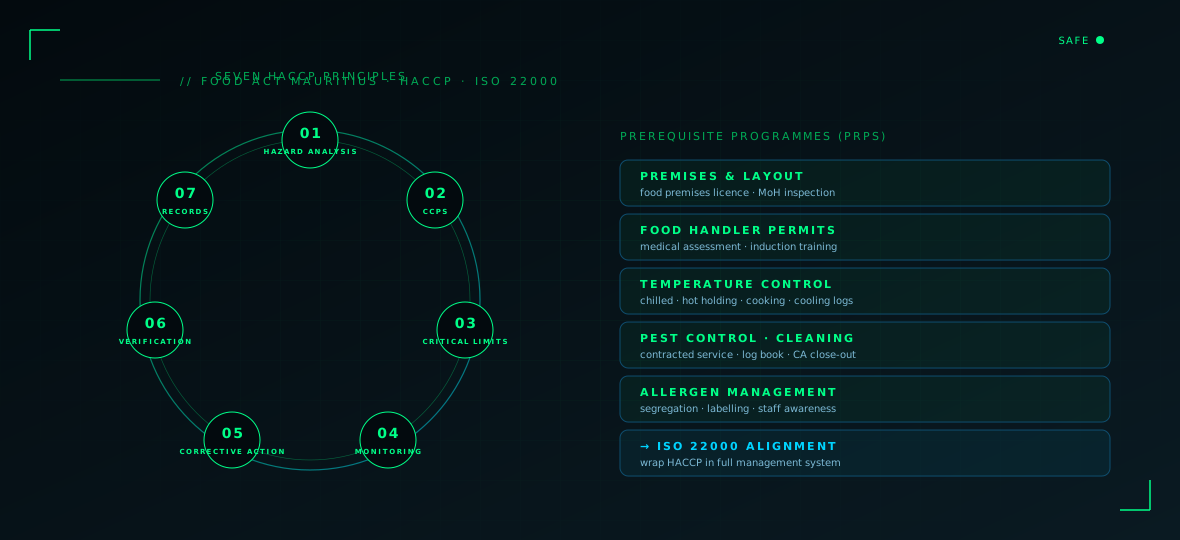
The seven HACCP principles arranged in a ring and the prerequisite programmes (PRPs) every Mauritian food business needs
Updated 12 June 2026Reading time 13 minRegion Mauritius

Statute

Food Act 1998

+ Food Regulations 1999

Methodology

HACCP (Codex)

7 principles · 12 steps

Compatible MS

ISO 22000:2018

incl. Amd 1:2024 · 2026 revision in DIS

Regulator

MoH · Health Insp.

plus local authority food officers

01Food safety in Mauritius — the regulatory base

Food safety in Mauritius is anchored in the Food Act and its regulations, administered by the Ministry of Health and Wellness through the Food Import Unit, Public Health Inspectorate and food laboratory infrastructure. The Act covers licensing of food premises, hygiene of food handlers, labelling, additives, contaminants and import controls. The regime sits alongside the Mauritius Standards Bureau (national standards) and, for export, the importing country's regulators.

Hospitality, food processing, supermarket and catering operators across Mauritius are subject to routine and reactive inspection. A failed inspection can stop service the same day. The reputational consequences are immediate and often permanent.

02Licensing of food premises

  • Food handler's permit — required for staff handling open food, after the prescribed medical assessment.
  • Food premises licence — from the local authority following inspection of layout, finishes, water supply, drainage, waste handling and pest control.
  • Trade licence covering food retail or catering, where applicable.
  • Sector-specific permits — import permits, meat handling, dairy, alcohol.
  • Renewals — diary the expiry dates centrally; lapsed permits are a frequent finding.

03HACCP — the seven principles

Hazard Analysis and Critical Control Points (HACCP) is the international framework for systematic food safety. The seven principles:

  • Conduct a hazard analysis — biological, chemical, physical hazards across the flow of food.
  • Determine the Critical Control Points (CCPs).
  • Establish critical limits for each CCP — measurable, science-based.
  • Establish monitoring procedures for each CCP.
  • Establish corrective actions when limits are breached.
  • Establish verification procedures — that the plan works as intended.
  • Establish documentation and record-keeping.

The prerequisite programmes — premises, equipment, training, pest control, waste, allergen management, supplier control — must be in place before HACCP can deliver on its promise.

04ISO 22000 — building a food safety management system

ISO 22000 wraps HACCP inside a full management system structure with leadership, planning, support, operation, performance evaluation and improvement. For Mauritian food businesses selling internationally, or supplying retail chains, ISO 22000 (often combined with FSSC 22000) is the recognised assurance instrument. For domestic operators, ISO 22000 brings operational discipline that pays for itself in reduced waste, reduced complaints and faster inspection turnaround.

05Allergen management and labelling

Mauritius regulations require labelling of allergens consistent with international practice. Operational controls are the harder part: dedicated equipment or strict cleaning between allergen-different production runs, segregation of allergen-containing ingredients in storage, allergen awareness for every member of staff who handles food, and a clear procedure for customer allergen enquiries — including when a confident "no" is the right answer.

06Inspection readiness

  • Documentation ready and current — licences, HACCP plan, training records, supplier approvals, temperature logs, pest control reports.
  • Premises visibly clean, with cleaning schedules signed and visible.
  • Staff in appropriate dress, hand-washing facilities working and stocked, no jewellery or open wounds on food handlers.
  • Temperature control calibrated and recorded — chilled storage, hot holding, cooking, cooling.
  • Pest control contract in place, with reports current and corrective actions closed out.

07Sector-specific notes

  • Hotels and resorts — multiple kitchens, banquet operations, room service, mini-bars. A single HACCP plan for the entire property, with site-specific annexes.
  • Restaurants — focus on cross-contamination, cooking and cooling, allergen disclosure.
  • Catering — transport temperature control is the highest-risk surface.
  • Food production — supplier assurance, traceability one step up and one step down, withdrawal and recall procedures.
  • Retail — receiving controls, stock rotation, temperature monitoring, customer complaint handling.
resources.consultation --book
Want a concrete plan for your context? Book a working session with our Mauritius consultants.