CC··
IP
TZ
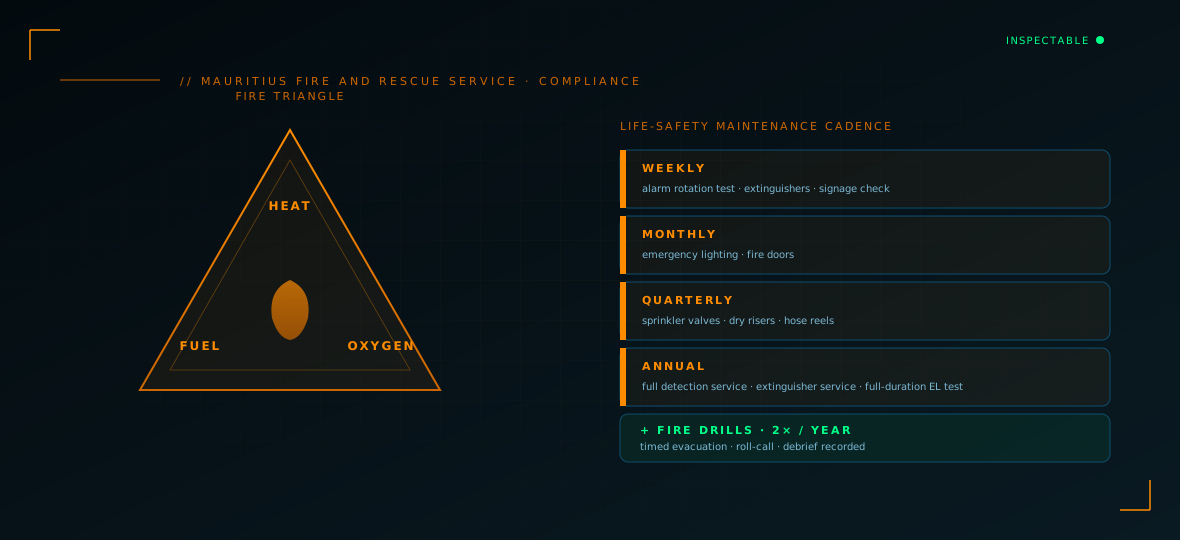
Fire triangle (heat, fuel, oxygen) with the Mauritius MFRS life-safety maintenance cadence — weekly, monthly, quarterly, annual and drills
Updated 12 June 2026Reading time 11 minRegion Mauritius

Authority

MFRS

Mauritius Fire and Rescue Service

Fire drills

2× per year

timed evacuation + debrief recorded

Annual cert.

Required

occupancy / fire-clearance certificate

Codes

NFPA · BS

practical reference standards

01Fire safety in Mauritius — the regulatory context

Fire safety in Mauritius is governed by the Mauritius Fire and Rescue Service Act and its regulations, administered by the Mauritius Fire and Rescue Service (MFRS) under the Ministry of Housing and Land Use Planning. The legal framework sits alongside the building, planning and occupational safety regimes. Where they overlap — for example a hotel kitchen, a manufacturing floor, a hospital — compliance must satisfy each statute, not just the most convenient one.

Routine compliance is straightforward; the risk surfaces hardest at change events — new buildings, layout changes, occupancy changes, new processes — where compliance is frequently forgotten until the next inspection or, worse, the next incident.

02Fire risk assessment

Every responsible person should commission and maintain a written fire risk assessment that covers:

  • Identification of fire hazards — sources of ignition, fuel, oxygen.
  • Identification of people at risk — employees, visitors, residents, people with limited mobility.
  • Evaluation of risk — likelihood of fire, severity of consequences, adequacy of existing measures.
  • Recording findings with prioritised corrective actions.
  • Review on material change and at planned intervals.

03Emergency action plan and evacuation

  • A written emergency action plan covering ignition, alarm activation, evacuation routes, assembly points, roll-call and re-entry.
  • Identified fire wardens with documented responsibilities and training records.
  • Drills at a defined cadence (twice a year is the working benchmark for most premises), with debrief and lessons-learned recorded.
  • Plans for people with limited mobility — Personal Emergency Evacuation Plans (PEEPs) for known cases, and a generic plan for visitors.
  • Communications protocol — who calls MFRS, who briefs senior management, who briefs media.

04Detection, alarm and suppression equipment

Maintenance of life-safety equipment is non-negotiable. A workable maintenance regime includes:

  • Weekly — alarm test (rotating call points), visual check of extinguishers and signage.
  • Monthly — emergency lighting function test, fire doors.
  • Quarterly — sprinkler valves, dry risers, hose reels.
  • Annual — full detection and alarm system service, extinguisher service, emergency lighting full-duration test, sprinkler system service.

All maintenance records must be kept in a log book and made available to MFRS during inspection. Outsourcing maintenance to a service contractor does not transfer the legal responsibility.

05Special hazards in Mauritian sectors

  • Hospitality — kitchen fire suppression, atrium smoke management, guest room evacuation, multi-language signage.
  • Manufacturing & logistics — combustible dust, hot work permits, segregation of hazardous storage, racking layouts.
  • Healthcare — defend-in-place strategies, oxygen storage, life-safety power supplies.
  • Data centres & ICT facilities — clean-agent suppression, very early smoke detection, controlled shutdown procedures.
  • Construction sites — temporary works, hot work, escape planning during phased works.

06MFRS inspections — what to expect

MFRS conducts routine and reactive inspections. Inspectors typically review documentation first (fire risk assessment, log book, drill records, maintenance certificates) and then walk the premises. Common findings include obstructed exits, blocked or pinned-open fire doors, expired extinguishers, missing or unreadable signage, and emergency lighting that fails the full-duration test. A clean inspection is the result of routine housekeeping rather than pre-visit panic.

07Integrating fire safety into a single management system

Fire safety should not live in a separate silo. The fire risk assessment, log book, training records and incident reports belong in the same management system as OSHA compliance, food safety (where applicable) and ISO 45001 — same audit cadence, same management review, same governance committee. We help clients build integrated management systems that prevent the duplication and contradictions that come from running these in parallel.

resources.consultation --book
Want a concrete plan for your context? Book a working session with our Mauritius consultants.